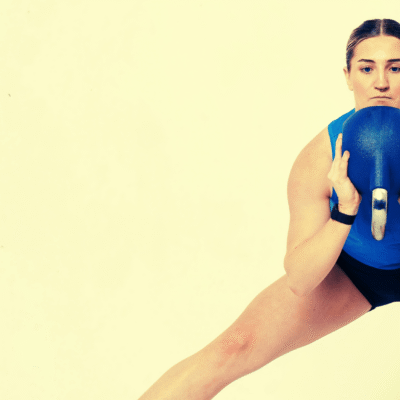


Stephanie Grimbly:
Full disclosure for those who are listening/reading: Dr. Justine Ward, Chiropractor and creator of Thirdzy Rest & Recover Collagen is my best friend. So you might assume I’m biased…
But I have witnessed her dig deep into scientific literature and develop her own evidence-based opinions about what’s good for human beings for nearly two decades. It’s easy for me to trust her.
However, I still wanted to test the product on myself—using my Garmin watch to track my recovery data—before recommending it to members of our community fitness clubs.
I’m pleased to report the impact on my recovery has been pretty remarkable.
Today Justine and I are going to discuss my results and what people can expect from using Thirdzy Rest & Recovery Collagen.
My first question is: how much individual variability in results should people expect?
Dr. Justine Ward:
Thank you for that flattering little disclaimer-slash-intro, friend. Crazy to think we’ve been friends for almost 20 years already.
To answer your question, there can be quite a bit of individual variability. People come into this with different levels of nutrient sufficiency, tolerances, genetics and life stress. So even though research can tell us what tends to happen across a population, an individual person’s experience can be quite different.
That’s why I think the individual experience is important—like you’ve done by testing the product and tracking your own results. An N-of-1 experience can tell you something about your own body and how it responds to supplementation—and the workouts that precede it, frankly.
Steph:
That makes sense. The product is just one variable of many that every individual has to tinker with to find the winning recipe for their body, goals and life.
Let’s talk about the ingredients themselves. Many people are already taking some of these as individual supplements. What role do collagen and magnesium play in recovery?
Dr. J:
Collagen and magnesium are nutrients that your body needs to perform standard functions properly, including tissue repair, regardless of whether you’ve been training.
Unfortunately, your body can be deficient in these nutrients without you necessarily realizing it. And if you’re training hard for Ironman or Hyrox or CrossFit Games, the deficiency can worsen. Thirdzy supports natural processes in any body, but it’s especially helpful for athletes.
The other two ingredients, GABA and L-theanine, support inhibitory pathways. Those pathways can be particularly relevant when someone’s sympathetic nervous system—the system associated with alertness and stimulation—has been running at a high level, such as when training for a competition.
The goal is to help counter some of that stimulation, slow the system down and increase parasympathetic activity so the body can move more effectively into a recovery state when it’s time to sleep.
Steph:
Let’s talk about HRV because I think that’s something a lot of athletes are starting to pay attention to. As the average Canadian becomes more interested in fitness and gadgets become more prevalent, they’re going to start tracking it too.
What should people actually be looking for with their Heart Rate Variability?
Dr. J:
There isn’t one universal “normal” HRV number. It’s much more useful to look at your own trends. Back to the N-of-1 experience!
Generally, a higher and increasing HRV is a positive sign because HRV reflects the variation in time between heartbeats. Greater variability is associated with greater adaptability, responsiveness and therefore resilience to the environment.
When someone is sick or under significant stress, the intervals between heartbeats can become more uniform, resulting in lower HRV.
Steph:
And what is the association with sleep and recovery?
Dr. J:
When you breathe in, your heart rate naturally increases slightly, and when you breathe out, it slows down. That variation contributes to HRV.
When someone isn’t sleeping well, their heart rate may not decrease as much during the night. That can be a sign that the parasympathetic nervous system—the “rest and digest” system—hasn’t taken control as effectively.
One of the goals of Thirdzy is to help the body move away from stimulation and toward that parasympathetic state, supporting more efficient recovery.
Steph:
One of our coaches experienced some grogginess when he first started using Thirdzy. I think people might expect to bounce out of bed every morning feeling totally refreshed if they use it. Why didn’t he feel that way?
Dr. J:
Thirdzy is intended to be a non-groggy solution. It is meant to be an alternative to Melatonin, which can “knock you out” and often makes you groggy the next day without actually improving your recovery.
Occasionally, someone may experience some initial grogginess using Thirdzy.
I’d bet that your coach is finally getting into a deeper parasympathetic sleep state after an extended period without it, and his body is taking the opportunity to catch up on sleep—particularly deep sleep—that he has been missing.
When the body finally gets that opportunity, it will take advantage of it. That deeper stage of sleep can make it more difficult to wake up initially.
For most people, that effect should diminish after a few nights as the body catches up on some of the sleep it has been missing.
Steph:
That actually checks out: this coach is in his early 20s, works early mornings for us Monday to Friday and has other side gigs some evenings and afternoons. I doubt he has been sleeping enough in terms of both quantity and quality.
What about cycling Thirdzy? Is there a reason someone should take it for a period of time and then stop?
Dr. J:
No. The physiological benefits don’t require cycling. A person might notice improvements in their recovery more readily by cycling between periods of better sleep and worse sleep.
But noticing more doesn’t mean you’re getting more. Consistency is more important because many of the benefits are related to maintaining nutrient sufficiency over time.
For nutrients such as magnesium and collagen, it can take up to 12 weeks to see tangible tissue-level effects. So it’s important not to judge the entire value of the product based only on how you feel after the first few nights.
Steph:
That fits really well with how we think about training. We run our gym in 13-week seasons, and we tell people that consistency is what allows the adaptation to happen. Recovery seems to work the same way.
Dr. J:
Absolutely. Consistency matters most.
The same principle applies to fitness, nutrition and recovery. You don’t necessarily see the full physiological effect immediately. You have to give the body enough time and consistency to adapt.
Steph:
How important are sleep habits and the sleep environment compared with taking a product like Thirdzy?
Dr. J:
They’re fundamental. A consistent sleep habit and a supportive sleep environment are the most important foundations for good sleep.
A product shouldn’t be viewed as a replacement for those things. Rather, Thirdzy can be another tool that supports the body’s recovery processes.
That may become particularly valuable for people whose schedules make consistency difficult—for example, first responders or shift workers.
Steph:
I also think there’s an interesting connection between recovery and longevity. For younger athletes, we’re often focused on performance. But as people get older, the priorities can change.
Dr. J:
They can. For our masters athletes, their focus is often toward fitness longevity, injury avoidance and recovery. Appropriate programming and adequate recovery can make a significant difference in managing energy and weight while helping people avoid injury.
Training provides the stimulus, but recovery is where the body has the opportunity to respond to that stimulus. And the older you are, the more support your body needs to adapt to it.
Steph:
That’s probably the biggest takeaway. Whether we’re talking about training, nutrition or sleep, the common denominator is consistency. More of a good reminder than a big reveal.
Dr. J:
Yes. We already know it’s true that the body—and mind—responds to consistency. What’s that saying? Repetition is the mother of all learning?
Whether we’re talking about training for an athletic competition or studying for a math exam, consistency beats intensity every time!
We offer fitness-minded folks a great recovery solution, but it will work best when it’s part of a multi-faceted and sustainable routine that also includes good sleep habits, appropriate training and nutrition.
Steph:
Thank you for taking the time to answer these questions about your product. You know I’m sold!
For those who would like to embark on their own N-of-1, personal rest and recovery experiment with Thirdzy Rest and Recover Collagen, click the link below to get 15% your first order with promo code:
getthegoodzzz